
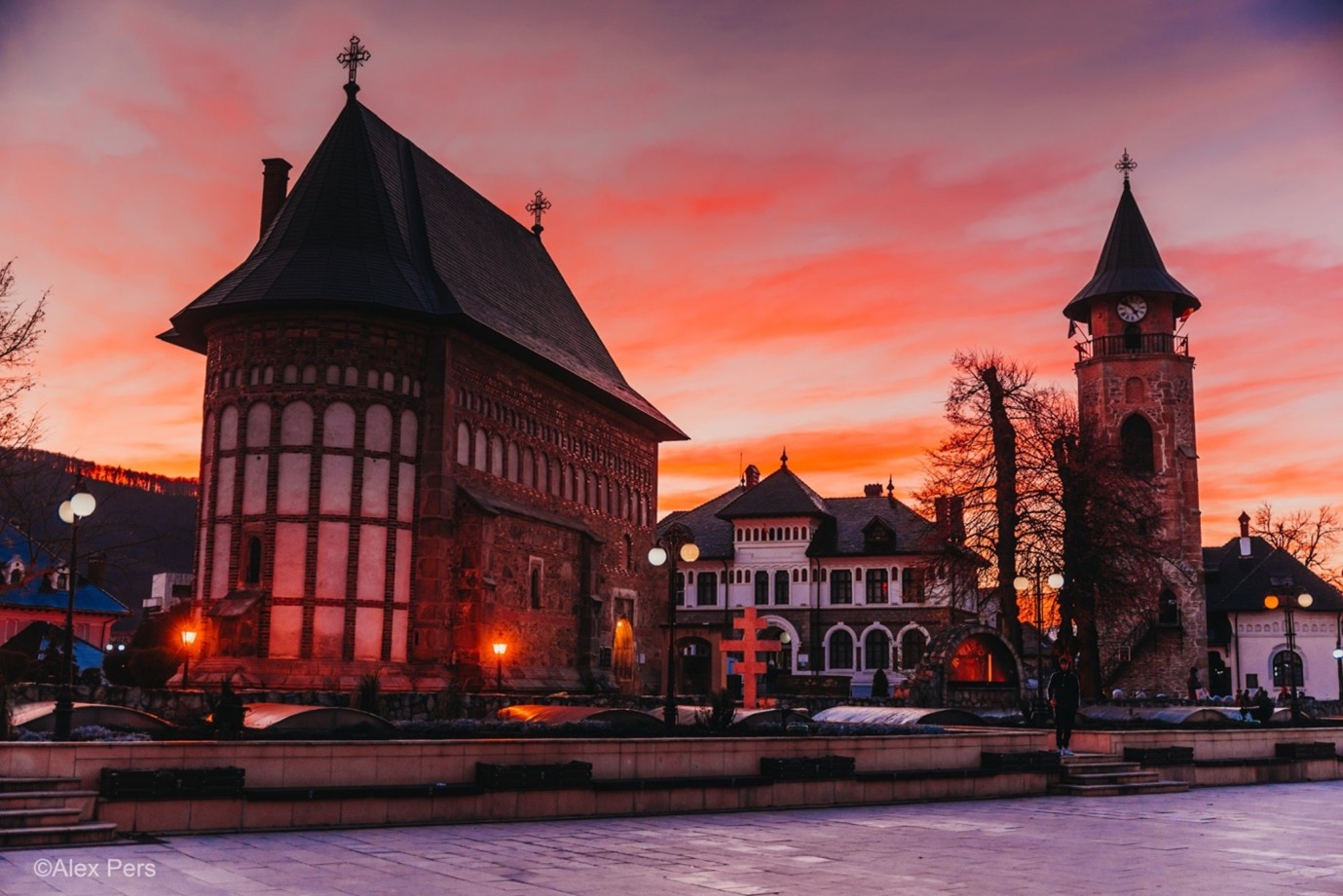
Located in the historic part of the city, the medieval complex "Curtea Domnească" in Piatra-Neamț includes medieval buildings representative of the era: the Church of St. John Domnesc, the bell tower, and the cellars of two royal houses.
The first documentary attestation of the Royal Court of Piatra-Neamţ appears in a document issued in 1491, when Stephen the Great donated three villages "which belonged to our courts in Piatra" to the Tazlău Monastery. The Royal Court fulfilled the administrative role of the Neamţ region and served as the court of the rulers of Moldavia until the 17th century.
The Royal Church of St. John the Baptist
The Church of the Nativity of St. John the Baptist in Piatra Neamţ, known as "Sfântul Ioan Domnesc" (St. John the Prince), is one of the best-preserved monuments among the foundations of St. Stephen the Great.
It was built between 1497 and 1498 in the Moldavian style, characteristic of Stephen's constructions, with Gothic accents.
The church is dedicated to St. John the Baptist and is always open to tourists from all over the world, with religious activities taking place here all the time.
Vechea catapeteasmă nu se mai păstrează, iar cea actuală a fost montată cu prilejul lucrărilor din 1868-1873, fiind sculptată de „Gherasim monahul şi Tănase săpătorul”, şi zugrăvită de către pictorii Panaite Mavrodin şi C.V. Basarab, după modelul de la Agapia.
Din tezaurul bisericii s-a păstrat un Tetraevangheliar, now housed in the Romanian History Museum. Written in Putna in 1502 by the hieromonk Spiridon, this manuscript bears the mention that it was commissioned by Stephen the Great for "his church dedicated to Saint John, from his courts on the Bistriţa River," rising to the value of a true work of art, through the rich ornamentation and miniatures that embellish the text. The new Pomelnic is also of particular historical interest., întocmit în 1792, care consemnează cele mai importante evenimente din existenţa acestei ctitorii voievodale.
Tower of Stephen The Great
A symbol of the city of Piatra-Neamt, Stephen the Great's Tower or Bell Tower was built in 1499, one year after the church was constructed. On the tower's façade, you can see brick belts and the famous small glazed and colored terracotta discs. Today, there are four bells in the bell chamber: the large one, from the 17th century, has a unique sound, one from the 19th century, and two more bells that were recently cast.
The mechanism of the first large clock of the Bell Tower was brought from Vienna in 1861. Over time, the clock mechanism was changed several times, and the existing one was installed in 1920, thanks to the contribution of local merchants.
Also functioning as a watchtower, its location was chosen with great skill and craftsmanship, as it had a clear view of the entire Bistriţa meadow, and the guards could see the valley where, to the east, the roads leading to Neamţ Fortress and Roman Market began, and to the south, towards the Bacău area.
An urban legend says that Saint George the Pilgrim lived in Stephen's Tower for 21 years, unique for his spiritual life.
Saint George the Pilgrim was born in 1846, in Șugag (now in Alba County), at a time when Transylvania was part of the Habsburg Empire.
Hearing about the numerous monasteries in Moldova, in 1895, Gheorghe crossed the Carpathian Mountains and settled in Piatra-Neamț, where he was given a small room in the bell tower of the Church of St. John the Prince. He remained there until the end of his life.
He was buried in the cemetery of Piatra-Neamț. Eighteen years later, one of his disciples, wanting to move his remains to Râșca, came with a cart to Piatra Neamț, dug him up, placed him in a coffin, and set off. But near the Văratec Monastery, the horses strayed from the road and the bones were taken to the Văratec Monastery, where they remain to this day. The Holy Synod of the Romanian Orthodox Church canonized him as a saint, with a day of remembrance on August 17.
Royal Cellar I
The exhibition space in the cellar displays artifacts discovered in the area of the Royal Court: coins, jewelry, and clothing accessories. The exhibition also features reconstructions of military equipment (breastplate, chain mail shirt, helmet, shield, etc.) and weapons (sword, sabre, axe, bow and arrows, etc.) typical of the medieval period.
In the entrance corridor and in the south aisle, there are a series of informative and illustrative panels presenting the origin and emergence of the medieval fair, the history and evolution of the Royal Court of Piatra, as well as data on the archaeological research conducted on the cellar of the Royal House.
Royal Cellar II
This cellar dates back to the 18th century. At the same time, the cellar overlaps two older ones, the first from the era of Alexander the Good, and the second from the period of Stephen the Great, which were once part of the Royal Court Ensemble. Historians say that this cellar served as a cellar where the wine barrels of the rulers of Moldavia were stored.


