
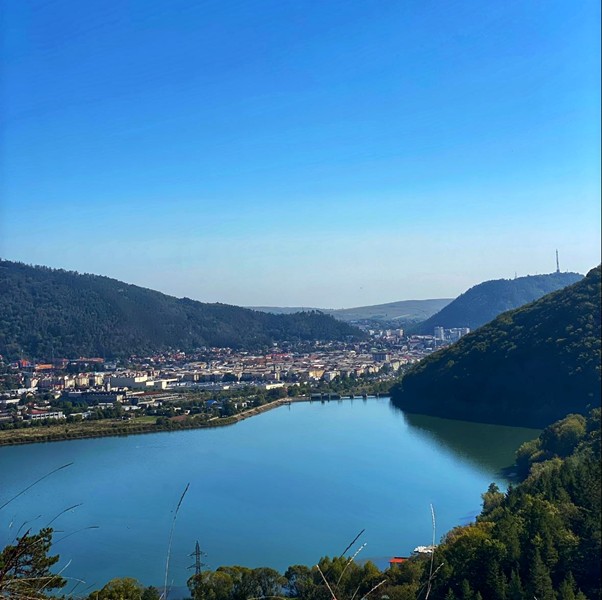
The name of the fortress Petrodava in Piatra-Neamț is mentioned by Ptolemy in his work "Geographia" in the description of Dacia, where 43 cities (fortresses) are listed.
The archaeological remains at Bâtca Doamnei were discovered in 1928 by the tireless scholar and researcher Constantin Matasă, founder of the History Museum in Piatra-Neamţ.
Archaeologists have discovered Dacian remains on Bâtca Doamnei Hill covering an area of almost 20,000 square meters and have identified two levels of habitation: one dating from the 2nd century BC, the other corresponding to the period between the 1st century BC and the 1st century AD.
Archaeological materials, as well as several coins discovered at Bâtca Doamnei, led researchers to assume that the settlement was founded in the 2nd century BC, but that its period of prosperity began in the following century and continued thereafter. The settlement was located on the banks of the Bârcova River, in the area of the former Bâtca Doamnei dam, where the remains of the dam's foundations were discovered.
Several dwellings have been identified within the fortress, all rectangular in shape, with stone foundations, log walls, and shingle roofs. A larger dwelling, probably with several rooms, located on the upper plateau of the fortress, may have been the residence of the local chieftain.
However, the most remarkable discovery at Bâtca Doamnei is the remains of two sanctuaries, whose layout and alignment of stone drums is similar to that of the Dacian sanctuaries identified in the fortresses of the Orastie Mountains.
During the excavations carried out here over several years, the usual inventory of Dacian settlements came to light: local and imported pottery (Hellenistic and Roman), iron tools, jewelry, stone grinders, etc. As research to date has shown, the fortress on Bâtca Doamnei was more of an acropolis, the political and religious center of the Dacians in the Neamţ region.
The end of the city was caused by a powerful fire. A devastating fire had also put an end to the first phase of this settlement.


