
Located in the northern part of Piatra-Neamț, Mount Cozla is an extension of the Stânișoarei Mountains, part of the last range of the Carpathians. Cozla reaches a height of 657 meters at the point called "Trei Coline" (Three Hills) and 670 meters at "Trei Căldări" (Three Cauldrons). The area at the foot of Mount Cozla is considered to be the cradle of the "Târgul Pietrei" of yesteryear, as it has been the most densely populated area for centuries, which led Stephen the Great himself to choose this location for the construction of the Royal Court in Piatra Neamț.
On Cozla, there was a Cucuteni settlement located at the highest altitude known for this type of dwelling in the entire region of Moldova. At the end of the 19th century, mineral waters were discovered on this mountain, which were an important attraction for a short time. The first paleontological discoveries in Romania were also made here. Today, the mountain is best known for its hiking trails and tourist infrastructure: cable car, chairlift, ski slope.
Cozla was reforested at the beginning of the 20th century, a few years after a natural disaster that marked the history of this mountain, but also of the city.
On the night of May 30-31, 1897, following heavy rains that lasted throughout that month, the mountain began to collapse from the top, slowly sliding downhill, covering all the people's homes beneath it. The terrified inhabitants fled, escaping with only their lives, while the landslide also covered most of the town hall's vacant lot, reaching almost to the street. When we saw this disaster the next morning, a pitiful sight met our eyes: the collapsed mountain formed huge cracks, ravines, and deep chasms, and an enormous mass of earth mixed with rocks and uprooted trees," recounts Dimitrie Hogea, former mayor of the city (1914-1918) in his work "From the Past of the City of Piatra-Neamţ."
In 1901, when Nicu Albu became mayor, he decided to reforest the mountain and build a park in order to stem the fury of the waters. For three years, hundreds of people worked to reforest the mountain, bringing 57,000 fir and pine trees from Sinaia, from the Royal Greenhouses. The effort was considerable, both for the planting itself and for the care of the seedlings, because during periods of drought, the locals carried water in buckets up the mountain to water them. The park was then built with promenade areas, a pavilion, and a buffet casino, and the official inauguration took place with great pomp on August 15, 1904, with the park being named Cozla Park. At that time, Nicu Albu made the memorable statement, "It was difficult, but we conquered nature." The wooden buildings were located on the site where the "Colibele Haiducilor" restaurant now stands, the first ones burning down completely two decades after the inauguration. At the base of the park, there was a zoo, which operated until 2021, when it was closed following a local public debate.
In 1882, chloride-sodium and sulphurous mineral springs were discovered in Cozla, studied at the time by Petru Poni and recommended for the treatment of digestive and circulatory disorders.
The initial discovery was made by chance. While visiting a patient in the Bordeie slum, Dr. Ștefan Predescu was offered water from a natural pool formed near his host's house to taste. The doctor realized that a saline mineral deposit had formed on the mountain and began to explore the area to find a spring. Five springs were discovered in this way. A commission was set up to study the healing properties of the waters, after which the help of scientist Petru Poni was requested. The results of the studies on the healing properties of the waters were positive, increasing interest in their exploitation.
Thanks to these, in 1889 the city was recognized as a spa resort. The mineral waters of Cozla were also appreciated at the 1900 World's Fair in Paris, where they won a bronze medal. Although these waters attracted thousands of tourists to Piatra Neamţ, over time, irrational exploitation and landslides led to their silting up.
The first Oligocene fish fossils in Romania were discovered on Cozla and Pietricica between 1883 and 1885. Thus, the study of fish fossils on Cozla began almost simultaneously with similar research in Western Europe.
În Piatra-Neamt și împrejurimi au fost identificate 4 zone fosilifere: Cernegura, Pietricica, Cozla și Agârcia, din acest motiv zona fiind numită ”Acvariul de Piatra”. Pe Cozla, în stratele de rocă alcătuite din conglomerate de marne și gresii, s-au descoperit depozite fosilifere de pești, cu specii variate.
Prezența acestora se datorează existenței aici în urmă cu 35 de milioane de ani a mării Paratethys, în care trăiau pești și scoici caracteristice zonelor subtropicale. Fosilele descoperite pot fi văzute la Muzeul de Științe Naturale din Piatra Neamț, care deține în continuare cea mai valoroasă colecție de pești oligoceni din țară și una din cele mai bogate din Europa.
Due to the richness of the Oligocene deposits, the Cozla, Pietricica, and Cernegura Mountains were declared paleontological reserves in 1971. Researchers' interest in studying the fossil-rich areas of Piatra-Neamț continues to grow, with foreigners also getting involved in research campaigns in the region.
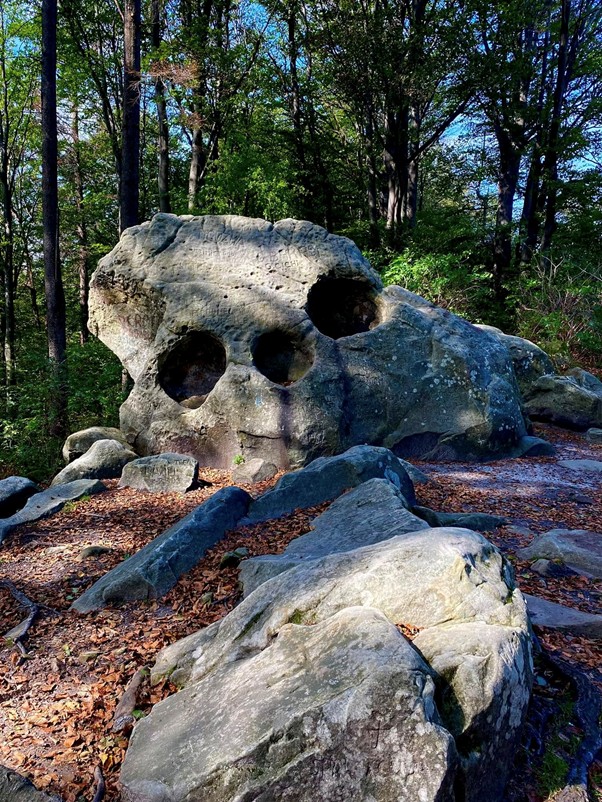
Another unique feature of Mount Cozla is the geological reserve located at its highest point (approximately 670 meters) called “Trei Căldări” (Three Cauldrons) or “Căldările uriașilor” (Giants' Cauldrons). These are wind-blown potholes, excavations measuring several tens of centimeters (approximately 60 cm) created by the prolonged action of the wind in harsh and cold climatic conditions.


